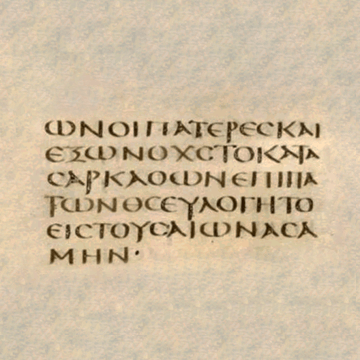
Romans 9:5

(“Who is overall…” To whom does the phrase refer — God the Father or Christ?)
“ΩΝΟΙΠΑΤΕΡΕϹΚΑΙΕΞΩΝΟΧ ϹΤΟΚΑΤΑϹΑΡΚΑΟΩΝΕΠΙΠΑΤΩΝΘϹ
ΕΥΛΟΓΗΤΟϹΕΙϹΤΟΥϹΑΙΩΝΑϹΑΜΗΝ”
GREEK TRANSLITERATION
“ŌN HOI PATERES KAI EX ŌN HO CHRISTOS TO KATA SARKA HO ŌN EPI PANTŌN THEOS EULOGĒTOS EIS TOUS AIŌNAS AMĒN”
ENGLISH TRANSLATION
“WHOSE ARE THE FATHERS AND FROM WHOM IS CHRIST ACCORDING TO THE FLESH WHO IS OVER ALL GOD BLESSED FOR EVER AMEN”
QUESTION
“KATA SARKA HO ŌN EPI PANTŌN THEOS…” (“according to the flesh who is over all God”) — to whom does the phrase refer — God the Father or Christ?
ROMAS 9:5 HAS BEEN controversial and heavily debated among biblical scholars when discussing how Apostle Paul’s words should be interpreted in the New Testament Greek. Proponents of the Christ-is-God claim that this passage undisputedly affirms Jesus’ deity despite the many Trinitarian scholars who do not believe this particular verse identifies Jesus as God; there are still those who try to use this verse to claim Jesus is being identified as “God.”
When we study the Greek New Testament, we must note that Koine Greek was written over 2000 years ago in all capital letters, with no spaces, no punctuation, and no accent marks; therefore, we have two sides to the argument as to which version of the bible provides the correct biblical rendition of this passage due to the ambiguity in the punctuation placement in Romans 9:5. Here are two translations we can compare:
KING JAMES VERSION
“…concerning the flesh Christ came, who is over all, God blessed for ever…”
OR
REVISED STANDARD VERSION
“…according to the flesh, is the Christ. God is over all be blessed forever…”
The question regarding those bible translations that refer to Christ as the “GOD” who is over all that should be blessed forever CORRECT?
If we accept any biblical translation that supports the position that Christ is God who is OVER ALL, it would not only contradict Apostle Paul’s writings between God and Christ but also many other passages of the biblical scriptures.
The following reference has this to say:
“This half verse has been the center of interminable controversy. The issue appears from a comparison of our two English texts. Is God over all, be blessed forever (or the one who is over all, God blessed forever) a phrase in apposition with ‘Christ’ and belonging in the same sentence as the rest of vs.5 (so the KJV and the RSV mg.), or is this phrase grammatically separate, a doxology to God at the end of the recital of the privileges of Israel (so the RSV and most modern translators?) The question cannot be answered on the basis of Greek since it is a matter almost entirely of punctuation, and Greek MSS in the early period were not punctuated.’ ‘…but the choice is probably to be made between the KJV and the RSV translations. The majority of modern commentators favor the latter because of the unlikelihood of Paul’s having here referred to Christ as ‘God’ (Θεός).”
(Reference: The Interpreter’s bible, vol. 9 p.540, Emphasis Mine)
“Although there are strong grammatical arguments to the contrary, the UBS textual committee prefers the reading represented in the TEV, principally on the basis that Paul elsewhere never calls Christ God. Most modern English translations prefer the rendering represented in the TEV (so RSV, NEB, NAB, Goodspeed, Moffatt).”
(Reference: A Translator’s Handbook on Paul’s letter to the Romans, p. 180, Emphasis Mine)
It should be added that Rom. 9:5 cannot be adduced to prove that Paul ever thought of Christ as God. The state of the case is found in the R.V. margin… He [Paul] never leaves the ground of Jewish monotheism. It has been pointed out that Rom. 9:5 cannot be brought in to question this statement. On the contrary, God is spoken of by the Apostle as not only the Father, but also the God of our Lord Jesus Christ.”
(Reference: The Doctrine of the Trinity, R. S. Franks, [a Trinitarian] Principal Emeritus of Western College in Bristol pp. 34-36, Emphasis Mine)
Scholars disagree that Christ is the one referred to as God who is over all that should be blessed forever. Admittingly, though, the lack of punctuation in the Greek text is absent, and it cannot just be a matter of Greek alone when it comes to its syntax in this particular passage. We, therefore, must focus on the overall biblical interpretation of what and who Christ is based on the entirety of scripture, especially on the belief of the Apostle Paul since he wrote the book of Romans. This is why Ellicott’s Commentary for English Readers stated the following:
“Who is over all, God blessed for ever.—These words are a well-known subject for controversy. Trinitarian and English interpreters, as a rule, take them with the punctuation of the Authorised version, as referring to Christ. Socinian interpreters, with some of the most eminent among the Germans, put a full stop after ‘came,’ and make the remainder of the verse a doxology addressed to God, ‘Blessed for ever be God, who is over all.’ Both ways are possible. The question is, Which is the most natural and probable? And this is to be considered, putting altogether on one side prepossessions of every kind. We are not to read meaning into Scripture, but to elicit meaning from it.”
(Reference: Ellicott’s Bible Commentary for English Readers, Charles John Ellicott, Romans 9:5, Emphasis Mine)
According to Ellicott, both ways or angles are possible, and the question is, what would be the more natural or probable interpretation? He also stated that we are not to read the meaning into scripture but to elicit meaning from it! So in other words in short, we still need to compare this passage with the overall entirety of the biblical scriptures to define God and Christ to see if there are any consistencies to conclude which is the correct interpretation of Romans 9:5. Ellicott’s commentary also further stated in his final opinion the following in regards to other passages of Apostle Paul which insinuates the unlikelihood of Apostle Paul referring to Christ as the God who is overall:
“…the fact that the words used by the Apostle, ‘Who is over all,’ and the ascription of blessing in all other places where they occur, are referred, not to Christ, but to God.”
(Reference: Ellicott’s Bible Commentary for English Readers, Charles John Ellicott, Romans 9:5, Emphasis Mine)
Therefore, based on Ellicott’s comment, Apostle Paul’s ascription of blessing in all other places where they occur, are referred, not to Christ, but to God.
In this case, what would be the preferred translation to ensure harmony and consistency with Apostle Paul’s writing and the biblical scripture regarding God and Christ, without creating contradiction? Let’s us read:
(ROM 9:5):
REVISED STANDARD VERSION

“To them belong the patriarchs, and of their race, according to the flesh, is the Christ. God is over all be blessed forever. Amen.”

TODAY’S ENGLISH VERSION

“They are descended from the famous Hebrew ancestors, and Christ, as a human being, belongs to their race. May God, who rules over all, be praised forever! Amen.”

MOFFATT TRANSLATION

“the patriarchs are theirs, and theirs too (so far as natural descent goes) is the Christ. (Blessed for evermore be the God who is over all! Amen.)”

NEW ENGLISH BIBLE

“Theirs are the patriarchs, and from them, in natural descent, sprang the Messiah. May God, supreme above all, be blessed for ever! Amen.”

Contemporary English Version

“They have those famous ancestors, who were also the ancestors of Jesus Christ. I pray that God, who rules over all, will be praised forever! Amen.”

———————————————

Note: Some words and phrases are in bold for emphasis.

Therefore, we now find Spiritual truth without biblical contradiction, in harmony with Apostle Paul’s statement:
“one God and Father of all, who is over all and through all and in all.”
(Reference: Eph. 4:6 NIV, Emphasis Mine)
Apostle Paul also clearly defined that it is God Himself who IS OVER ALL; this includes OVER our Lord Jesus Christ, further validating that the OVER ALL refers to God and NOT to Christ in Romans 9:5. Once again, let us have Apostle Paul further validate his above statement but this time from the book of Corinthians:
“For the scripture says, ‘God put all things under his feet.’ It is clear, of course, that the words ‘all things” do not include God himself, who puts all things under Christ. But when all things have been placed under Christ’s rule, then he himself, the Son, will place himself under God, who placed all things under him; and GOD WILL RULE COMPLETELY OVER ALL.”
(Reference: I Cor. 15:27-28 GNB, Emphasis Mine)
Thus, it is evident that it is God, THE FATHER, who is OVER ALL and does not refer to Christ. Moreover according to the consistent writings of the Apostle Paul, Christ himself, who is subordinate to the Father and will place Himself under God’s rule on the Day of Judgment, and God will rule completely over all, even over our Lord Jesus Christ. This passage alone should shut all doors to any Trinitarian inference of Romans 9:5.
In addition, Apostle Paul himself clarified his belief about the true God. Let us read:
“yet for us there is but one God, the Father…”
(Reference: I Cor. 8:6 NIV, Emphasis Mine)
The God of Apostle Paul is none other than the Father, as he declared, “yet for us there is but one God, the Father…!” 
In addition, Apostle Paul did not teach that Christ is God but that the “man Christ Jesus” is our “one Mediator” with God:
“For there is one God and one Mediator between God and men, the man Christ Jesus.”
(Reference: I Tim. 2:5, NKJV, Emphasis Mine)

IN CONCLUSION

1

Apostle Paul could never have called Christ God in Romans 9:5 since that would contradict his other pronouncements in the Bible — something which the learned apostle would never do.

2

The statement “God who is over all be blessed forever” is a doxology or praise to God for His blessings to the Israelites. It does not refer to Christ.

3

Comparing these two verses gives a clear view of the correct rendition of the passage:
“…according to the flesh, is the Christ. God is over all be blessed forever. Amen” (Romans 9:5, RSV, Emphasis mine)
“one God and Father of all, who is over all and through all and in all.(Ephesians 4:6, NIV, Emphasis mine)

4

Bible scholars themselves prefer the Revised Standard Version (RSV), of Romans 9:5 over that of other versions that may give any indication that Christ is “over all” due to the contradictive implications that would arise against Paul’s writing elsewhere pointing to the Father being the one who is “over all,” e.g. (Eph. 4:6), and Christ being a man and Mediator between God and man (I Tim. 2:5).

WE KINDLY EXTEND our visitors an invitation to explore the pristine, unadulterated teachings of Christ and His apostles as they were taught in the first-century Church Of Christ:

The Truth about God and Jesus Christ

SUPPORTERS OF THE BELIEF in the divinity of Christ, also known as the Christ-is-God or the God-man doctrine, assert that God exists as a trinity consisting of the Father, Son, and Holy Spirit. Although they are three in nature and considered distinct beings, proponents maintain that they form a single God. The concept of the Trinity lacks explicit biblical endorsement; thus, proponents often argue that it represents a profound mystery beyond human comprehension and should be accepted by faith alone.

Reach Out

If you wish to acquire a deeper understanding of our Church Doctrines and have any questions, please do not hesitate to reach out to us. We would be delighted to direct you to one of our local resident ministers in your vicinity. Kindly include any queries you may have so that we may forward your inquiry in advance. Thank you.

Please note, we only read and respond to messages that do not contain hate speech or insults...

“Do not let unwholesome [foul, profane, worthless, vulgar] words ever come out of your mouth, but only such speech as is good for building up others, according to the need and the occasion, so that it will be a blessing to those who hear [you speak].”
(Eph. 4:29, Amplified Bible)
“Love endures with patience and serenity, love is kind and thoughtful, and is not jealous or envious; love does not brag and is not proud or arrogant. It is not rude; it is not self-seeking, it is not provoked [nor overly sensitive and easily angered]; it does not take into account a wrong endured.”
(1 Corinthians 13:4-5, Amplified Bible)