I Timothy 3:16

(Who was manifested in the Flesh?)
AN ARGUMENT often put forth by the proponents of the Trinitarian doctrine claims that “God was manifested in the flesh” or that God became a human being in the person of Jesus Christ. They base their argument on 1 Timothy 3:16 of the King James Version of the Bible, which reads:
“And without controversy great is the mystery of godliness: God was manifest in the flesh, justified in the Spirit, seen of angels, preached unto the Gentiles, believed on in the world, received up into glory.”
(Reference: 1 Timothy 3:16 KJV, Emphasis Mine)
Although the above verse reads as “God was manifest in flesh,” the majority of Trinitarian Bible Translations read it as: “He was manifest in flesh.” Many Scholars agree that the word “God” was NOT present in the original text but was added later by scribes. The earliest and most reliable manuscripts do not contain the word “God” in them, but rather “He,” “who,” or “which.” Furthermore, even modern (Trinitarian) Bible Translations disagree with the King James Version and a few other translations for inserting the word “God” in 1 Timothy 3:16. Let’s now show what the different Bible translations put for 1 Timothy 3:16:
American Standard Version 1901

“And without controversy great is the mystery of godliness; He who was manifested in the flesh.”

Complete Jewish Bible (CJB)
“Great beyond all question is the formerly hidden truth underlying our faith: He was manifested physically and proved righteous spiritually,”
Douay-Rheims 1899
“And evidently great is the mystery of godliness, which was manifested in the flesh,”
English Standard Version Anglicised (ESVUK)
“Great indeed, we confess, is the mystery of godliness: He was manifested in the flesh.”
NET Bible (©2006)
“And we all agree, our religion contains amazing revelation: He was revealed in the flesh.”
Holman Christian Standard Bible (©2009)
“And most certainly, the mystery of godliness is great: He was manifested in the flesh.”
Lexham English Bible (LEB)
“And most certainly, great is the mystery of godliness: Who was revealed in the flesh,”
Aramaic Bible in Plain English (©2010)
“And this Mystery of Righteousness is truly great, which was revealed in the flesh and was justified in The Spirit”
Mounce Reverse-Interlinear New Testament (MOUNCE)
“And undeniably great is the mystery of godliness, who was revealed in flesh.”
Revised Standard Version
“Great indeed, we confess, is the mystery of our religion: He was manifested in the flesh”
Douay-Rheims
“And evidently great is the mystery of godliness, which was manifested in the flesh.”
New English Translation (NET)
“And we all agree, our religion contains amazing revelation: He was revealed in the flesh.”
New International Version (NIV)
“Beyond all question, the mystery from which true godliness springs is great: He appeared in the flesh.”
New American Standard Bible
“By common confession, great is the mystery of godliness: He who was revealed in the flesh.”
New Revised Standard Version (NRSV)
“Without any doubt, the mystery of our religion is great: He was revealed in flesh.”
English Standard Version
“Great indeed, we confess, is the mystery of godliness: He was manifested in the flesh”
Revised Version 1881
“And without controversy great is the mystery of godliness; He who was manifested in the flesh.”
The Voice (VOICE)
“And I think you will agree that the mystery of godliness is great: He was revealed in the flesh.”
(*Emphasis added to context)
From the above, we see that the trinitarian Bible translations all agree that the word “God” is NOT in there. This alone should refute the KJV translation of this particular passage. However, because there are still quite a considerable number of hard-headed Trinitarians who will insist that I Timothy 3:16 in the KJV is right and other translations are wrong, we will, therefore, take it a step further and provide concrete evidence by going directly to the source of the Greek Manuscripts that do not have the word “God” (Theos) in it from Brooke Foss Westcott and Fenton John Anthony Hort, both Professor of Divinity of Cambridge (In Red Markings):
καὶ ὁμολογουμένως μέγα ἐστὶν τὸ τῆς εὐσεβείας μυστήριον· ὃς [who] ἐφανερώθη ἐν σαρκί, ἐδικαιώθη ἐν πνεύματι, ὤφθη ἀγγέλοις, ἐκηρύχθη ἐν ἔθνεσιν, ἐπιστεύθη ἐν κόσμῳ, ἀνελήμφθη ἐν δόξῃ.”
(Reference: The New Testament In The Original Greek, Brooke Foss Westcott, D. D. and Fenton John Anthony Hort, D.D., New York Harper & Brothers, Franklin Square 1881, Emphasis Mine)
And also from Constantin von Tischendorf 8th Ed. (In Red Markings):
“καὶ ὁμολογουμένως μέγα ἐστὶν τὸ τῆς εὐσεβείας μυστήριον· ὃς [who] ἐφανερώθη ἐν σαρκί, ἐδικαιώθη ἐν πνεύματι, ὤφθη ἀγγέλοις, ἐκηρύχθη ἐν ἔθνεσιν, ἐπιστεύθη ἐν κόσμῳ, ἀνελήμφθη ἐν δόξῃ.”
(Reference: New Testament in Koin Greek based on Tischendorf 8th Ed. 1869, Emphasis Mine)
CORRUPT TRANSLATIONS ON 1 TIMOTHY 3:16:
SCHOLARS COMMENTING ON 1 TIMOTHY 3:16 THAT MADE IT INTO THE CORRUPTED TRANSLATIONS WE SEE TODAY:

1

John Albert Bengel:

“Theos of the rec. Text has none of the oldest MSS. In its favour, no version as early as the seventh century: and as to the fathers, ex. Gr. Cyril of Alex. And Chrysostom, quoted for theos, sec Tregelles on the printed text of N. T., in which he shows these fathers are misquoted. Theodoret, however does support it. Liberatus, Victor Tununensis (both of 6th cent.), affirm that Macedonius, under the Emperor Anastasius, changed OC into theos in order to support Nestorianism. AC corrected, G, read OC. So Memph. And Theb. The old Latin fg and Vulg. Have quod, referring to…, taken as a personal designation for the antecedent. The Syr. Peschito, and in fact all versions older than the seventh cent., have the relative NOT theos. D (A) corrected, alone of the uncials, favours O. The silence of the fathers of the fourth cent., though theos would have furnished them with a strong argument, is conclusive against it.” (John Albert Bengel, Gnomon of the New Testament, p.268, Emphasis Mine)

2

Anthony Buzzard:

“Another example of a text which was altered is 1 Timothy 3:16. This verse reads in the KJV: “God was manifested in the flesh.” Modern versions have corrected the word “God” to “He who.” The alteration of an original “He who” (in Greek Oj) was very sneakily accomplished when some scribes changed the O (omicron) into a q (theta) giving qj (theta sigma). The reading THS was an abbreviated form of the Greek word theos, God. All that had to be done was to draw a little line across the middle of the O to produce the Greek letter theta (q). Then the text was made to sound Trinitarian and to support the Incarnation: “God was manifested in the flesh.” “He who” (Oj) was made to read “God” (qj).” (Anthony Buzzard, Jesus Was Not a Trinitarian: A call to return to the creed of Jesus, p.257, Emphasis Mine)

3

Isaac Newton:

“All the Churches for the first four or five hundred years, and the authors of all the ancient versions, Jerome, as well as the rest read ‘Great is the mystery of godliness, which was manifested in the flesh.'”(Isaac Newton, Historical Account Of Two Notable Corruptions Of Scripture: In A Letter To A Friend, p.58, Emphasis Mine)

4

Bart D. Ehrman:

“The passage in question, 1 Tim. 3:16, had long been used by advocates of orthodox theology to support the view that the New Testament itself calls Jesus God. For the text, in most manuscripts, refers to Christ as “God made manifest in the flesh, and justified in the Spirit.” As I pointed out in chapter 3, most manuscripts abbreviate sacred names (the so called nomina sacra), and that is the case here as well, where the Greek word God (QEOS) is abbreviated in two letters, theta and sigma (QS), with a line drawn over the top to indicate that it is an abbreviation. What Wettstein noticed in examining Codex Alexandrinus was that the line over the top had been drawn in a different ink from the surrounding words, and so appeared to be from a later hand (i.e., written by a later scribe). Moreover, the horizontal line in the middle of the first letter, Q, was not actually a part of the letter but was a line that had bled through from the other side of the old vellum. In other words, rather than being the abbreviation (theta sigma) For “God” (QS), the word was actually an omicron and a sigma (OS), a different word altogether, which simply means ‘who.’ The original reading of the manuscript thus did not speak of Christ as ‘God made manifest in the flesh’ but of Christ “who was made manifest in the flesh.” According to the ancient testimony of the Codex Alexandrinus, Christ is no longer explicitly called God in this passage.“(Bart D. Ehrman, Misquoting Jesus, p.113, Emphasis Mine)

5

Johann Jakob Griesbach:

“This reading OS, is supported by most ancient witnesses of all classes [manuscripts, versions, and Fathers] and it is recommended also, by its internal indications of truth. On the contrary, the Vulgate Theos, was neither the primitive reading of the Alexandrine, nor of the Western recension: and further, it cannot be defended by arguments drawn from nature [or goodness] of the reading itself; but it is supported only by a number of manuscripts of a later date, belonging chiefly to the Constantinopolitan recension; and by the dubious credit to the more modern Greek Fathers; and could not be found in any monument of antiquity, prior to the close of the fourth century.” (Johann Jakob Griesbach, Novum Testamentum Graece; volume 3., Emphasis Mine)

6

Professor of the New Testament, Reverend Benjamin B. Warfield:

“Expert paleographer differ diametrically as to what the reading of A is, whether Theos or OC, and in the present worn state of the MS. Decision by renewed examinations is impossible. The same kind of controversy has been held as to the reading C, although apparently with much less reason; and although we have unclosed C also in doubting: parentheses we entertain no great doubt as to its support of OC. A large proportion of the versions so deliver their testimony as to make it indeterminable whether they read OC or O; they have been placed in both lists in-closed in brackets, as its existence has been doubted. Codex 73 has been personally examined by Dr. Schaff, and certainly reads OC. On applying genealogical considerations to this evidence, all the testimony that is at all certain for theos sifts out with the sifting out of the Syrian testimony. This reading appears in no father until late in the fourth century, in no version until at least the seventh century, and in MSS. Until long after the Syrian text had become everywhere the virtual textus receptus. On Genealogical grounds, thus theos is at once set aside, and the choice rests between OC and O. It can scarcely be doubted that O is Western; while the attestation (A) C 17 gives OS the appearance of having the support of the neutral and Alexandrian classes. The doubt that hangs Genealogical evidence of groups corroborates this finding. AC or C alone is of the best groups attainable in this part of the New testament. The transcriptional evidence comes to our help by making it improbable that O can be the correct reading and hence enabling us to account all the testimony for both OS and O combined against that for theos. The result is to condemn theos hopelessly.” (Professor of the New Testament Reverend Benjamin B. Warfield D. D. An Introduction to the textual criticism of the New Testament (1886), pp.194 – 195., Emphasis Mine)

7

Andrews Norton:

“The original reading I believe to have been O which for this the external; evidence when fairly adjusted, seems greatly to preponderate; and it may have been altered by transcribers first into OS, and afterwards into theos, in consequence of the theological interpretation of the passage, according to which the mystery spoken of was Christ; – I believe has no reference to Christ personally. The words translated ‘mystery of godliness’ as if purposely to obscure the sense, should be rendered the new doctrine of piety, or concerning piety…” (Andrews Norton, A Statement of Reasons, pp.132, Emphasis Mine)

8

Richard N. Longenecker:

“Passages in Paul where theos is employed of Christ are lacking. The appeal to 1 Timothy 3:16 is undoubtedly illegitimate, for the reading ‘who (Oc) was manifested in the flesh’ has much stronger textual support than ‘God (theos) was manifested in flesh.‘” (Richard N. Longenecker, The Christology of Early Jewish Christianity, p.139, Emphasis Mine)

9

Dr. Samuel Clark:

“It has been great controversy among learned men, whether theos or OC, or O be the true reading in this place. All the old versions have it qui or quid [who or which]. And all ancient Fathers though the copies of many of them have it NOW in the text itself, theos [God]; yet from the tenor of their comments upon it, and from their never citing it in the Arian controversy, it appears they always read it, qui or quid.” (Samuel Clark Scripture The Doctrine of the Trinity, p.540, Emphasis Mine)

10

Murray J Harris

“…In fact all the ancient versions presuppose the relative pronoun, whether OC or O and the earliest uncial in the original hand that reads theos dates from the eighth or ninth century. Also the earliest patristic citation of theos dates from the last third of the fourth century. Whereas Origen (d.254) more than a century earlier testifies to OC. The Strength of the external evidence favouring OS along with considerations of transcriptional and intrinsic probability, have prompted textual critics virtually unanimously to regard OC as the original text… Accordingly 1 Timothy 3:16 is not an instance of the Christological use of theos. The Conclusion we have reached about each of the secondary passages discussed in this chapter is identical—and negative. In every case textual or grammatical considerations rule out the possibility that Jesus is called theos.” (Murray J. Harris Jesus as God, The New Testament, pp.267 – 268, Emphasis Mine)

11

Bruce M. Metzger:
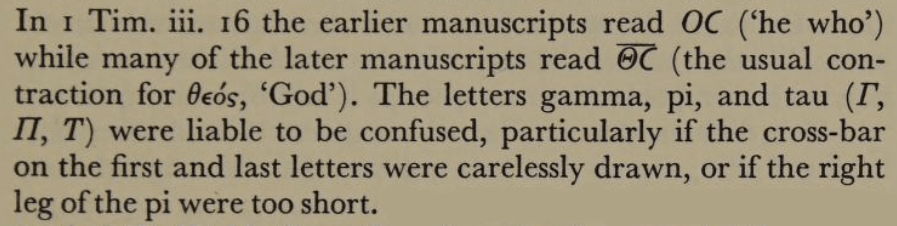
“Thus, no uncial (in the first hand) earlier than the eighth or ninth century (ѱ) supports θεός [theos]; all ancient versions presuppose ös or ö; and no patristic writer prior to the last third of the fourth century testifies to the reading θεός [theos]. The reading θεός  [theos] arose either (a) accidentally, through the misreading of oc as θc, or (b) deliberately, either to supply a substantive for the following six verbs, or, with less probability, to provide greater dogmatic precision.” (Bruce Metzger, A Textual Commentary on the Greek New Testament, United Bible Society, New York, 1975, p.641., Emphasis Mine)
In addition, in: “THE TEXT OF THE NEW TESTAMENT Its Transmission, Corruption and Restoration,” by Bruce Metzger on p.187, he states:
The overwhelming evidence presented by scholars agrees that 1 Timothy 3:16 does NOT say “God was manifest in the flesh,” but instead, “He was manifest in the flesh,” referring to Christ. It was due to a scribe that the Greek word “OC” was changed into “theos.” The majority of the scholars and experts further showed that the earliest manuscripts they have available do not read God (theos) but “he,” “who,” or “which.”
When properly translated, 1 Timothy 3:16 actually argues against the Trinity. Let us read:

“By common confession, great is the mystery of godliness: He who was revealed in the flesh, Was vindicated in the Spirit, Seen by angels, Proclaimed among the nations, Believed on in the world, Taken up in glory.”

(Reference: NASB, Emphasis Mine)
Who was the “He” who was taken up in glory? Obviously, it was the Lord Jesus Christ after his resurrection. Therefore, this section of Scripture beautifully portrays an overview of Christ’s life and accomplishments. It all fits with what we know of the man and Lord Jesus Christ. If Jesus were God, this section of Scripture would have been the perfect place to say so. We should expect to see some phrases like “God incarnate,” “God and Man united as one God,” “very God and very Man,” etc., etc. But nothing like that occurs. Instead, the section perfectly testifies to Christ as a man who was revealed in the flesh and was taken up in glory.

IN CONCLUSION

1

According to the evidence, Scholars agree that the word “God” was NOT present in the original text but was added later by scribes. Thus, Wettstein noticed in examining Codex Alexandrinus was that the line over the top had been drawn in a different ink from the surrounding words, and so appeared to be from a later hand (i.e., written by a later scribe). Moreover, the earliest and most reliable manuscripts do not contain the word “God” in them, but rather “He,” “who,” or “which.” Thus, the evidence of forgery is quite evident.

2

If Jesus were God, this section of Scripture would have been the perfect place to say so. We should expect to see some phrases like “God incarnate,” “God and Man united as one God,” “very God and very man,” etc., etc.

3

When properly translated, 1 Timothy 3:16 actually argues against the Trinity.

4

Many modern versions of the bible have corrected the use of the word “God” to “He,” “who,” or “which” for the simple and plain fact that it was Jesus Christ who was manifested or made flesh by God, as mentioned in John 1:14.
WE KINDLY EXTEND our visitors an invitation to explore the pristine, unadulterated teachings of Christ and His apostles as they were taught in the first-century Church Of Christ:

The Truth about God and Jesus Christ

SUPPORTERS OF THE BELIEF in the divinity of Christ, also known as the Christ-is-God or the God-man doctrine, assert that God exists as a trinity consisting of the Father, Son, and Holy Spirit. Although they are three in nature and considered distinct beings, proponents maintain that they form a single God. The concept of the Trinity lacks explicit biblical endorsement; thus, proponents often argue that it represents a profound mystery beyond human comprehension and should be accepted by faith alone.

Reach Out

If you wish to acquire a deeper understanding of our Church Doctrines and have any questions, please do not hesitate to reach out to us. We would be delighted to direct you to one of our local resident ministers in your vicinity. Kindly include any queries you may have so that we may forward your inquiry in advance. Thank you.

Please note, we only read and respond to messages that do not contain hate speech or insults...

“Do not let unwholesome [foul, profane, worthless, vulgar] words ever come out of your mouth, but only such speech as is good for building up others, according to the need and the occasion, so that it will be a blessing to those who hear [you speak].”
(Eph. 4:29, Amplified Bible)
“Love endures with patience and serenity, love is kind and thoughtful, and is not jealous or envious; love does not brag and is not proud or arrogant. It is not rude; it is not self-seeking, it is not provoked [nor overly sensitive and easily angered]; it does not take into account a wrong endured.”
(1 Corinthians 13:4-5, Amplified Bible)