Genesis 1:26-27

(Was God speaking to Christ in the plan of creation?)
“Then God said, ‘Let us make man in our image, after our likeness… So God created man in his own image, in the image of God he created him; male and female he created them’.” (Genesis 1:26-27 ESV, Emphasis mine)
GENESIS 1:26 HAS frequently been invoked by those who subscribe to the Trinitarian doctrine as their so-called “evidence” that the God of the Old Testament was addressing His son, Jesus Christ, during the creation of mankind. They alleged that in this passage, God the Father is addressing Christ as the “second person” of the Trinity when God said, “Let us make man in our image.” They alleged that since God used the pronoun “us,” He was talking to Jesus as God the Son. Notice, however, that in the first chapter of Genesis, there was no mention of the terms “Son and “Holy Spirit.” Moreover, God created man in His (singular) own image. In the image of God, He (singular) created him. Male and female He (singular) created them. The Trinitarians are pointing to something not explicitly stated or present in the verse. It is simply their assumption, a product of their imagination that drove them to conclude that the passage supports their Trinity doctrine. According to scholar Michael S. Heiser:
“Many Bible readers note the plural pronouns (us; our) with curiosity. They might suggest that the plurals refer to the Trinity, but technical research in Hebrew grammar and exegesis has shown that the Trinity is not a coherent explanation.”
(Reference: Michael S. Heiser, The Unseen Realm, Bellingham, WA: Lexham Press 2015, p. 39, Emphasis Mine)
We first must understand that the book of Genesis was written in the Hebrew language, and as such, the word “God” is translated as “Elohim.” This term, in and of itself, is a plural form and, like most other words, has more than one definition. It is used in the plural sense of “gods” or “men with authority” and in the singular sense “God,” “god” or a man with authority, such as a “judge.” The Hebrew Lexicon by Brown, Driver, and Briggs, which is widely considered to be one of the best references available has this to say for the usage of Elohim:
rulers, judges, either as divine representatives at sacred places or as reflecting divine majesty and power, divine ones, superhuman beings including God and angels, gods.”
(Reference: Francis Brown, The Brown-Driver-Briggs Hebrew and English Lexicon, Hendrickson Pub., Massachusetts, 1906, p. 43, Emphasis Mine)
As well as the Oxford Dictionary of the Christian Church explains further:

ELOHIM (Heb. אֱלֹהִ֔ים, lit. ‘gods’). Used occasionally in the OT of heathen gods, supernatural beings, or earthly judges, but generally of the God of Israel, for whom it is a very frequent term, esp. in what is commonly reckoned the second oldest Pentateuchal source (the supposed writer of which is therefore referred to by critics as ‘the Elohist’). The use of the plural form to describe the one God is frequently explained as a ‘plural of majesty’.”

(Reference: The Oxford Dictionary of the Christian Church Edited by by F.L. Cross and E.A. Livingstone page 454., Published by London Oxford University Press New York Toronto 1958, 1974, Emphasis Mine)
In addition, the New Catholic Encyclopedia further supports this view:

ELOHIM. The form Elohim, when used of the God of Israel, is plural of majesty,… The Israelites, however, used Elohim for their one and only God,He is seen as the creator God endowed with all-embracing power, the ruler of absolute will *Yahweh, the God of Israel, is the only God, and there is no other…”

(Reference: New Catholic Encyclopedia, Vol. 5, P. 287, Nihil Obstat: John P. Whalen, M.A., S.T.D., Censor Deputatus, Imprimatur: Patrick A. O’Boyle, D.D. Archbishop, Emphasis Mine)
Therefore, with careful analysis of the Hebrew scripture, we can clearly conclude that the verse indicates “majesty” and not “number.” Some even go to the extent of saying that the word Elohim implies a compound unity when it refers to the true God. That would mean that the word Elohim somehow changes meaning when applied to the true God so that the true God can be a compound being. There is just no evidence of this. The first place we should go for confirmation of this is to the Jews themselves. When we study the history and the language of the Jews, we discover that they never understood Elohim to imply a plurality in God in any way. In fact, the Jews were staunchly opposed to people and nations who tried to introduce any hint of more than one God into their culture. Jewish rabbis have debated the Law to the point of tedium and have recorded volume after volume of notes on the Law, yet in all of their debates, there is no mention of a plurality in God. This fact alone, in and of itself, ought to close the argument.
No higher authority on the Hebrew language can be found than the great Hebrew scholar Gesenius. He wrote that the plural nature of Elohim was for intensification, related to the plural of majesty, and used for amplification, not numerical plurality. Gesenius states: 
That the language has entirely rejected the idea of numerical plurality in אֱלֹהִ֔ים (’ĕ-lō-hîm,) (whenever it denotes one God) is proved especially by its being almost invariably joined with a singular attribute.”
(Reference: E. Kautzsch, ed., Gesenius’ Hebrew Grammar, Clarendon Press, Oxford, 1910, 1960 p.399, Emphasis Mine)
Now that we have established the true definition and meaning of “Elohim” as God being “ONE” and not a compound unity or numerical plurality within Himself, the question now remains: To whom was God speaking when He said, “Let us make man in our image,” and what did He mean by it? Does it imply that God had help from someone other than Himself in creating mankind?
The answer is much more straightforward, one that an ancient Israelite would have readily discerned. What we have is a single entity (God) addressing a group — the members of his divine council. This scenario can be analogous to a speaker entering a room surrounded by friends and voicing, “Let us bake a cake!” In this analogy, the individual is the one speaking, while the group of friends hears what he says. However, the individual who proceeds to execute the task of baking and creating the cake is none other than the speaker himself! In like manner, God comes to the divine council with an exciting announcement: “Let’s create humankind!” Therefore, God is speaking to his divine council; does that suggest that God’s council helped Him in the creation of mankind? Was the creation of mankind a group project? Not at all. Back to the cake illustration, if the speaker is the sole executor carrying out the plan after announcing it, then the speaker retains both the inspiration and the initiative for the entire project of baking the cake, the same as with God as depicted in Genesis 1:26.
So if God alone is the acting force of the entire creation of mankind and was not speaking to alleged Christ, who then was God addressing when He spoke those words?
The book of Revelations will give us the answer as to who the audience is who surrounds His throne and whom God was addressing:

All the angels stood around the throne and the elders and the four living creatures, and fell on their faces before the throne and worshiped God. …

“Then I looked and heard the voice of many angels, numbering thousands upon thousands, and ten thousand times ten thousand. They encircled the throne and the living creatures and the elders.” (Rev. 7:11 NKJV; 5:11 NIV, Emphasis Mine)
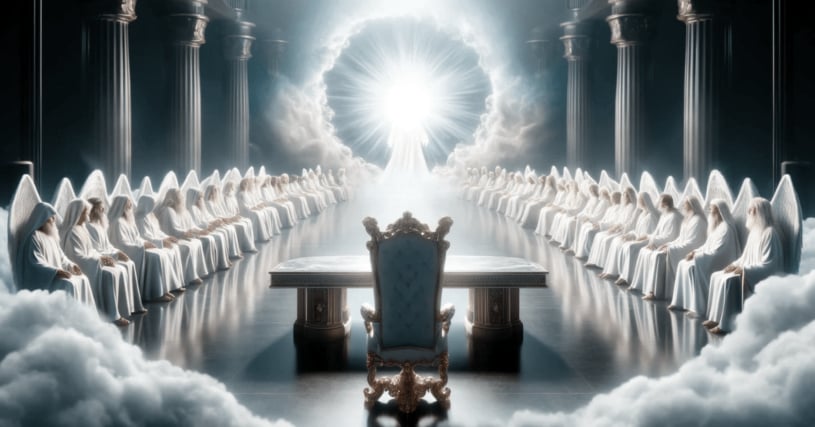
It is evident that God had an audience during His creation, which consisted of His angels that encircled His heavenly (court or throne). Therefore, it can be concluded that God is not alone. However, with regards to the works of creation, the question is did God have any assistance in creating mankind and all that exists within? Let us consult once again the Holy Scriptures:
“… I am the LORD, the Creator of all things. I alone stretched out the heavens; when I made the earth, no one helped me.”
(Reference: Isa. 44:24 GNT, Emphasis Mine)
Note that God, who is the Father, is the creator of all things; He further stated that “I alone” and  “no one helped me.” Therefore, He ALONE created all things. Reading this from the NIV translation further validates this position that God alone created all things. Let us read:
“… I am the LORD, the Maker of all things, who stretches out the heavens, who spreads out the earth by myself.”
(Reference: Isa. 44:24 NIV, Emphasis Mine)
Take note. God said, “by myself.”
Both translations support that God, who is the Father, is the ONLY Creator, and He alone created all things. Thus, to say that God was addressing Jesus Christ as the second person of the “Trinity” is biblically unfounded. Also, the name of Christ is nowhere to be found in the passage.
In addition, the translators of the New American Bible, Revised Edition, provide an honest admission in the footnote on Genesis 1:26 stating:
“…God was imagined as presiding over an assembly of heavenly beings…”
(Reference: Footnote: New American Bible, Revised Edition, Emphasis Mine)

IN CONCLUSION

1

God is addressing His heavenly court and all the angelic beings that surround His throne.

2

God retained both the inspiration and the initiative for His entire creation.

3

No one helped God in the creation of mankind. God alone created all things.

4

God was not addressing our Lord Jesus Christ and the name Jesus or the Holy Spirit is not found anywhere in the passage of Genesis 1:26. It is the assumption of trinitarians wanting to read into something that is simply not their. A product of their imagination that drove them to conclude that the passage supports their Trinity doctrine.

5

The translators of the New American Bible, Revised Edition provided an honest admission in the footnote stating:
“…God was imagined as presiding over an assembly of heavenly beings …”

6

The word אֱלֹהִ֔ים (‘ĕ-lō-hîm,) refers to the Father and denotes one God, and the Hebrew word ‘ĕ-lō-hîm, has entirely rejected the idea of numerical plurality in God.

7

ELOHIM… The use of the plural form to describe the one God is frequently explained as a ‘plural of majesty.’

8

Proponents of the Christ is God doctrine suggest that the plurals form (‘ĕ-lō-hîm,) may refer to the Trinity, but technical research in Hebrew grammar and exegesis has shown that the Trinity is not a coherent explanation.
WE KINDLY EXTEND our visitors an invitation to explore the pristine, unadulterated teachings of Christ and His apostles as they were taught in the first-century Church Of Christ:

The Truth about God and Jesus Christ

SUPPORTERS OF THE BELIEF in the divinity of Christ, also known as the Christ-is-God or the God-man doctrine, assert that God exists as a trinity consisting of the Father, Son, and Holy Spirit. Although they are three in nature and considered distinct beings, proponents maintain that they form a single God. The concept of the Trinity lacks explicit biblical endorsement; thus, proponents often argue that it represents a profound mystery beyond human comprehension and should be accepted by faith alone.

Reach Out

If you wish to acquire a deeper understanding of our Church Doctrines and have any questions, please do not hesitate to reach out to us. We would be delighted to direct you to one of our local resident ministers in your vicinity. Kindly include any queries you may have so that we may forward your inquiry in advance. Thank you.

Please note, we only read and respond to messages that do not contain hate speech or insults...

“Do not let unwholesome [foul, profane, worthless, vulgar] words ever come out of your mouth, but only such speech as is good for building up others, according to the need and the occasion, so that it will be a blessing to those who hear [you speak].”
(Eph. 4:29, Amplified Bible)
“Love endures with patience and serenity, love is kind and thoughtful, and is not jealous or envious; love does not brag and is not proud or arrogant. It is not rude; it is not self-seeking, it is not provoked [nor overly sensitive and easily angered]; it does not take into account a wrong endured.”
(1 Corinthians 13:4-5, Amplified Bible)