1 John 5:7

(The ‘Johannine comma’)
“For there are three that bear record in heaven, the Father, the Word, and the Holy Ghost: and these three are one.”
(1 John 5:7 NKJ, Emphasis mine)
THIS VERSE is usually cited by Trinitarians, who are unaware of the spurious addition to the passage to prove their contention. The verse in the King James Version and Douay-Rhiems Version mentioned that “the Father, the Word, and the Holy Ghost: and these three are one.” This is conveniently called the “Johannine Comma.” Why can the (Johannine comma) not be used as the basis for the Trinity doctrine?

THE JOHANNINE COMMA CAN NOT BE FOUND IN MANY ENGLISH VERSIONS OF THE BIBLE

Although 1 John 5:7 of the King James Version, and Douai-Rehiems Version, mentioned that “the Father, the Word, and the Holy Ghost: and these three are one,” this phrase cannot be found in the majority of Bible versions. Many of the versions that contain the “Johannine Comma” are descendants of the King James Version and, ultimately, the Latin Vulgate. In fact, over 20 Bible versions have removed this spurious addition of (1 John 5:7) from their translation.  Let us compare just a few:

NEW AMERICAN STANDARD BIBLE

“For there are three that testify …”

(Reference: 1 John 5:7)

NEW INTERNATIONAL VERSION

“For there are three that testify …”

(Reference: 1 John 1:7)

ENGLISH STANDARD VERSION

“For there are three that testify …”

(Reference: 1 John 5:7)

NEW REVISED STANDARD VERSION

“There are three that testify …”

(Reference: 1 John 5:7)

THE CORRUPTED TRANSLATION CAN NOT BE FOUND IN THE ANCIENT GREEK TEXT OF THE EARLY MANUSCRIPTS

The following is the Greek text of I John 5:7 based on Nestle-Aland 27th edition:
“ὅτι τρεῖς εἰσιν οἱ μαρτυροῦντες” (Greek)
“Hóti treís eisin hoi marturoúntes” (Greek Transliteration)
“For three there are that record” (English Translation)

THE JOHANNINE COMMA IS ABSENT IN ALL ANCIENT GREEK MANUSCRIPTS AND OTHER ANCIENT VERSIONS OF THE NEW TESTAMENT

The New Catholic Encyclopedia, Vol. VII, S.V.,  has this to say about the “Johannine Comma”:

“The Comma is absent in all the ancient Greek manuscripts of the New Testament with the exception of four rather recent manuscripts that date from the 13th to 16th centuries. The Comma is lacking in such ancient Oriental versions as the Peshitta, Philoxenian, Coptic, Ethiopic, and Armenian. While the majority of the Latin manuscripts of 1 John do contain the Comma, the earlier and better manuscripts, both of the Old Latin and Vulgate versions, lack it. The earliest manuscript in which it appears dates from the 9th century. The Fathers of the East do not quote or refer to the Johannine Comma in their Christological controversies. This omission indicates that the Comma was not part of the biblical text of their time, for they surely would have used it had it been in the text. Some 4th-century Latin writers, while referring to 1 John 5.8b and giving this a Trinitarian interpretation, failed to give any indication that they knew of the existence of the Comma as a scriptural passage.“

(Reference: New Catholic Encyclopedia, Vol. VII, S.V. “Johannine Comma, Emphasis Mine)

Of the thousands of Greek manuscripts, only four contain the “Johannine Comma,” but they are recent manuscripts dating from the 13th to 16th century. Ancient versions of the New Testament did not contain it. Even the ancient manuscripts of the Old Latin and Latin Vulgate did not contain it, and the earliest manuscript of the Latin Vulgate that contains it dates from the 9th century AD.

THE ROMAN CATHOLIC CHURCH ADMITTED THAT ITS GENUINENESS IS TO BE DENIED OR DOUBTED

Although the Roman Catholic Church at first insisted that the “passage” is authentic, but afterwards, declared that the genuineness of the passage is to be denied or doubted:
“In recent times the doubts concerning its authenticity have grown and the Holy Office in 1927, declared that, after careful examination of the whole circumstances, its genuineness could be denied.”
(Reference: Fundamentals of Catholic Dogma, p.56, Emphasis Mine)
Due to the fact that the “Johannine Comma” cannot be found in ancient manuscripts of the New Testament, the Roman Catholic Church finally admitted and declared that “its genuineness could be denied.”

IT STARTED AS A "MARGINAL GLOSS" BUT INCORPORATED IN THE OLD LATIN TEXT IN THE 5TH CENTURY AND IN THE TEXT OF THE LATIN VULGATE IN 800 AD

The New Catholic Encyclopedia testified that “Johannine Comma” started as a “gloss” (commentary) but later on found its way into the passage:
“The development of the Comma can be followed in the ecclesiastical writers of the late 4th and 5th centuries, especially in Spain and Africa. Apparently, it developed as a result of the Trinitarian interpretation of the triad: spirit-water-blood found in 1 John 5.8b. By way of a gloss on the sacred text it eventually found its way into the text itself.”
(Reference: New Catholic Encyclopedia, Vol. VII, S.V. “Johannine Comma”, Emphasis Mine)
From the “margin,” it was incorporated into the text of the Old Latin about the 5th century AD:
“In the course of the fifth century, it was incorporated from the margin into the text of an Old Latin (pre-vulgate) manuscript.”
(Reference: The Epistle of John, p.129, Emphasis Mine)
The Johannine Comma was incorporated in the text of the Latin Vulgate only in 800 AD:
“It was not incorporated into the text of the Vulgate until about A.D. 800, but once incorporated it remained there securely…”
(Reference: The Epistles Of John, p. 129, Emphasis Mine)
The Douay-Rheims translation is based on the Latin Vulgate, which is why the “Johannine Comma” can be found in it.

WHY WE CAN FIND THE JOHANNINE COMMA IN THE KING JAMES VERSION

The following narrated how the “Johannine Comma” found its way to the King James Version (Authorized Version), although it was not found in ancient Greek Text:
“when Erasmus published his first printed edition of the Greek New Testament (1516) he was attack for omitting ‘the three heavenly witnesses’, he replied reasonably enough that he found them in no Greek manuscript. Rather incautiously he added that, if a Greek manuscript could be produced which contained the passage, he would include it. In due due course such a Greek manuscript was produced – by no means an ancient one, for it was written about 1520…so in his next edition (the third edition, 1522) he included it, adding a footnote in which he complained that the manuscript had been written with the express purpose of putting him on the spot. From Erasmus’ third edition the passage was translated into German (by Luther) and into English (by Tyndale); it was taken over into other early printed editions on the Greek New Testament, and hence appears in the Authorized Version.”
(Reference: The Epistles of John p.129, Emphasis Mine)
Therefore, the “Johannine Comma” cannot be used as basis to prove the Trinity doctrine because this was originally not part of I John 5:7 but merely a “marginal gloss” incorporated in the verse that the earliest manuscript of the Latin Vulgate containing it dated 800 A.D. (9th century A.D.), and the four Greek manuscripts containing it dated from 13th to 16th A.D. only. The Johannine Comma cannot be found in all ancient Greek manuscripts and ancient versions of the New Testament.

1 John 5:7 Manuscript History Trail ("Johannine Comma"):
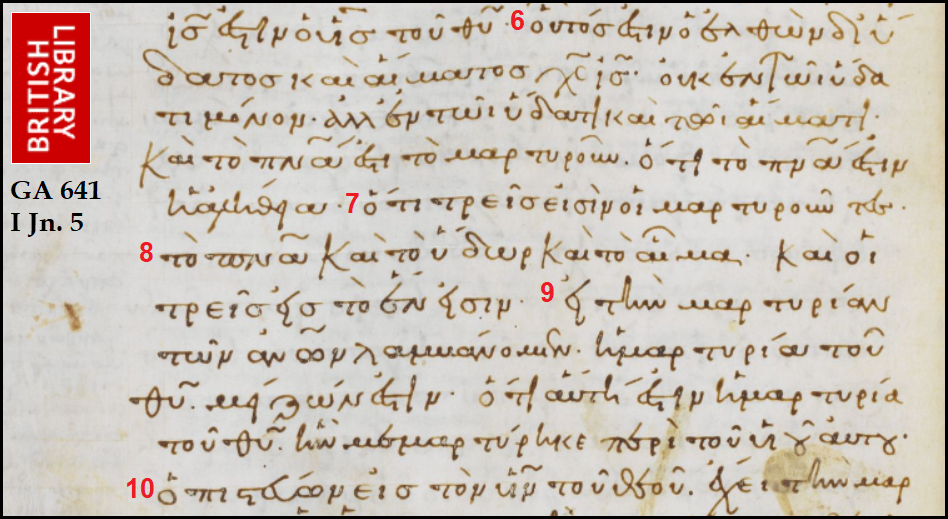
GA 641: The Comma Johanneum is absent and was never there to begin with…

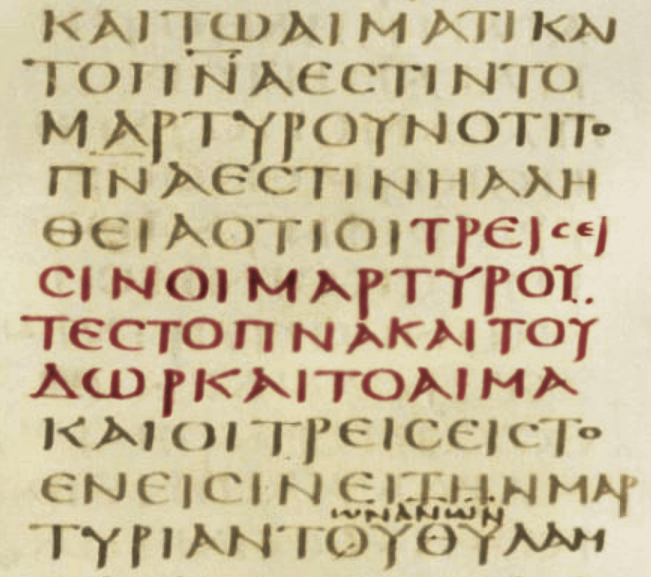
Excerpt from Codex Sinaiticus:

1 John 5:7-9. It does not contain the Johannine Comma. The burgundy-colored text says:
“THERE ARE THREE WITNESS BEARERS, THE SPIRIT AND THE WATER AND THE BLOOD”

IN CONCLUSION

1

The spurious corrupted translation, which is traced back to a “marginal gloss” was first incorporated in the verse found in the earliest manuscript of the Latin Vulgate, which dates back to 800 A.D. (9th century A.D.). This translation then found its way into the four Greek manuscripts, which are dated from the 13th to 16th A.D. The Johannine Comma, however, is notably absent in all ancient Greek manuscripts and ancient versions of the New Testament.  The Roman Catholic Church also admitted and declared that “its genuineness could be denied.” 

2

Of the thousands of Greek manuscripts, only four contain the Johannine Comma, which has been documented to appear as early as the seventh century. Even there, it appears only in manuscripts of Spanish provenance from the history of the Latin Vulgate in medieval Spain. The Johannine Comma is not only spurious but anachronistic with respect to the Epistle of John.

3

Many of the later bible versions that we see today that contain the “Johannine Comma” are descendants of the King James Version and, ultimately, the Latin Vulgate. In fact, over 20 Bible versions have removed this spurious addition of (1 John 5:7) from their translation.

4

The correct Greek Manuscript translation of 1 John 5:7-8, without the addition of the spurious and corrupted text, reads:
 “CΙΝΟΙΜΑΡΤΥΡΟΥΤΕCΤΟΠΝΑΚΑΙΤΟΫΔΩΡΚΑΙΤΟΑΙΜΑ”
“There are three witness bearers, the spirit and the water and the blood”. (English Translation)

Additional Historical Notes

"Johannine Comma" ( 1 John 5:7 )

The NT was originally written in Greek, yet the oldest manuscript in which this text is found is in the Latin manuscripts of the seventh century. It was eventually accepted into the Latin Vulgate in the Clementine edition 1592. It only appears in eight Greek manuscripts, none of which can be dated before 1400. However, even in these eight manuscripts, it is evident that the text was translated from Latin back into Greek. In fact, in four of the eight manuscripts, the text is found only in the margins and not in the Bible text itself. Now, if the text is original, then there is no good explanation for its omission in the early manuscripts.
If the text is authentic and part of John’s original writing, one wonders why not one Greek or Latin Church Father ever quoted the passage in the first 450 years of the Church. Given that the early Church councils centered around the doctrine of the Trinity (Nicea in 325; Chalcedon in 451), one would expect this text, if it is authentic, to have been a central point of discussion. The fact that it was not even mentioned points to it being a later addition to John’s writing. So, how did it make its way into the King James Version of the Bible?
Desiderius Erasmus was a prominent NT Greek scholar in the 16th century, and by his hand, the modern Greek Bible began to come together. He rejected the Johannine Comma in the first two editions of his Greek NT (1516, 1519), so it did not appear in either of those editions. When he was criticized by those who were familiar with it from the Latin versions for omitting it, Erasmus wrote to one of them saying, “If a single manuscript had come into my hands, in which stood what we read in the Latin Vulgate, then I would certainly have used it to fill in what was missing in the other manuscripts I had. Because that did not happen; I have taken the only course which was permissible, that is, I have indicated in the annotations what was missing from the Greek manuscripts.” Later, Erasmus told his detractors that if any Greek manuscript could be found with the reading, he would include it in his next edition of the Greek NT.
Shortly after, a Greek manuscript containing the Johannine Comma was presented to Erasmus. There is little doubt that it was fabricated to force Erasmus to include it in his next edition, and Erasmus knew this to be the case. However, true to his word, in the third edition of his Greek NT, Erasmus included the Johannine Comma. It is worth noting that he chose to exclude it from all subsequent editions. Despite this, the inclusion of the Comma in the third edition of his Greek NT had a lasting impact, as it was subsequently included in later versions like Stephanus’ edition (1550), which was a precursor to the Greek manuscripts behind the KJV.
WE KINDLY EXTEND our visitors an invitation to explore the pristine, unadulterated teachings of Christ and His apostles as they were taught in the first-century Church Of Christ:

The Truth about God and Jesus Christ

SUPPORTERS OF THE BELIEF in the divinity of Christ, also known as the Christ-is-God or the God-man doctrine, assert that God exists as a trinity consisting of the Father, Son, and Holy Spirit. Although they are three in nature and considered distinct beings, proponents maintain that they form a single God. The concept of the Trinity lacks explicit biblical endorsement; thus, proponents often argue that it represents a profound mystery beyond human comprehension and should be accepted by faith alone.

Reach Out

If you wish to acquire a deeper understanding of our Church Doctrines and have any questions, please do not hesitate to reach out to us. We would be delighted to direct you to one of our local resident ministers in your vicinity. Kindly include any queries you may have so that we may forward your inquiry in advance. Thank you.

Please note, we only read and respond to messages that do not contain hate speech or insults...

“Do not let unwholesome [foul, profane, worthless, vulgar] words ever come out of your mouth, but only such speech as is good for building up others, according to the need and the occasion, so that it will be a blessing to those who hear [you speak].”
(Eph. 4:29, Amplified Bible)
“Love endures with patience and serenity, love is kind and thoughtful, and is not jealous or envious; love does not brag and is not proud or arrogant. It is not rude; it is not self-seeking, it is not provoked [nor overly sensitive and easily angered]; it does not take into account a wrong endured.”
(1 Corinthians 13:4-5, Amplified Bible)