The Transformation from the first-century Church Of Christ to the Roman Catholic Church
MANY ARE AGHAST, if not incredibly surprised at the teaching of the Iglesia Ni Cristo or Church Of Christ that emerged in the Philippines in 1914, proclaiming that it is the true Church established by Christ. There are even those who do not include it among the so-called “Christian” churches because the Jesus Christ it preaches is not God but the Son of God, Savior and a very special man. The prevailing belief is that the Catholic Church is the only church that can claim historical roots back to the first century and, thus, is the true Church founded by Jesus Christ.
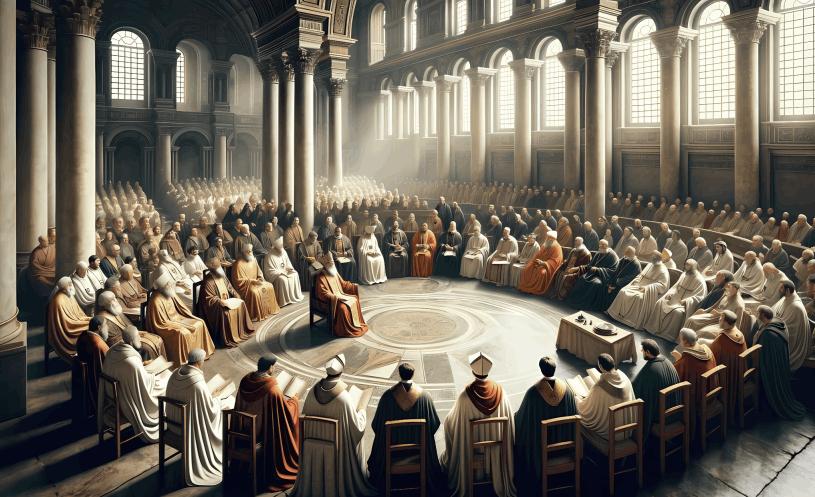
CATHOLIC CLAIM OF HISTORICITY
A Catholic Nun, Ma. Veritas Grau stated:
“The name of the Church founded by Jesus Christ is the Catholic Church…. It is clear that the Church founded by Christ must be able to trace its origin in an unbroken line back to the Apostles. This means not only that her leaders, and especially the Pope, must be genuine successors of the Apostles. It means also that the doctrine and the basic moral norms these leaders preach, and the means of grace they administer, must be of apostolic origin.” (The Creed, Ma. Veritas Grau, D.S.P. [Revised Ed.], Pasay, Metro Manila, Philippines: Daughters of St. Paul Publication 1984, pp. 205, 215, Emphasis Mine)
In addition, the Funk and Wagnalls New Encyclopedia states thus:

“ROMAN CATHOLIC CHURCH, collective designation for the portion of Christendom that acknowledges the supremacy of the pope and considers submission. to papal authority in matters of faith an indispensable condition of membership in its ranks. The Roman Catholic Church regards itself as the only legitimate inheritor, by an unbroken episcopal succession descending from Saint Peter to the present time, of the commission and powers conferred by Jesus Christ upon the twelve Apostles…”
(Reference: Funk and Wagnalls New Encyclopedia, p.349, Emphasis Mine)
CATHOLIC FAITH IN JESUS NOT DERIVED FROM SCRIPTURES
It is very easy to see that Catholic beliefs and practices are not found in the Bible. Catholics do not see this as a problem; in fact, they are even proud of it. Karl Adam, in his book The Spirit of Catholicism, says:
“Without the Scripture,’ says Mohler, ‘the true form of the sayings of Jesus would have been withheld from us, … Yet the Catholic does not derive his faith in Jesus from Scriptures.”
(Reference: The Spirit of Catholicism by Karl Adam, Pub: 1930, p. 49, Emphasis Mine)
According to the above statement, Catholics do not derive their faith in Jesus from the Scriptures. This is contrary to the biblical teachings that true faith comes from hearing the true teaching of God (Rom. 10:17). So where did the Catholic Church adopt many of her teachings? From paganism, as stated by two prominent Catholic authors. John Gilland Brunini, in his book Whereon to Stand: What Catholics Believe and Why, states:
“In her methods she has borrowed from many sources-from the Jewish ecclesiastical system from Roman, and hence pagan, religious and civil procedures.”
(Reference: Whereon To Stand: What Catholics Believe And Why by John Gilland Brunini, Pub: 1961, p. 316, Emphasis Mine)
Rev. John F. Sullivan, in his book The Externals of the Catholic Church, says:
“Thus, it is true, in a certain sense, that some Catholic rites and ceremonies are a reproduction of those pagan creeds.”
(Reference: The Externals of the Catholic Church by Rev. John F. Sullivan, Pub: 1951 p. 226, Emphasis Mine)
Yet, what do Catholics say of the fact that their faith cannot be identified with primitive Christianity, nor even with the gospel of Christ? Karl Adam, in his book mentioned above, says:
“We Catholics acknowledged readily, without any shame, nay with pride, that Catholicism cannot be identified simply and wholly with primitive Christianity, nor even with the Gospel of Christ, in the same way that the great oak cannot be identified with the tiny acorn.”
(Reference: The Spirit of Catholicism by Karl Adam, Pub: 1930, p.2, Emphasis Mine)
Thus by their own admission, Catholic authorities accept that the original Church Of Christ established by Christ and administered by the apostles is the tiny acorn that cannot be compared to the great oak which is the Catholic Church.
THE GREAT CHANGE
Apostle Paul vehemently warned the members of the first-century Church Of Christ against destructive changes, thus:
“… Though we, or an angel from heaven, preach any other gospel unto than that which we have preached unto you, let him be accursed. As we said before, so say I now again, If any man preach any other gospel unto you than that ye have received, let him be accursed.”
(Reference: Gal. 1:8-9, King James Version)
The Church Of Christ gained a foothold in Rome through the missionary works of Apostle Paul is indisputable. But even during his lifetime, Apostle Paul spent a lot of energy warding off false teachings as can be seen in his sometimes very angry letters. And when he died, history records that false teachers, now rid of the presence of the apostle, finally succeeded in infiltrating the Church Of Christ. The World’s Great Events states:
“At first the history of the Roman Church is identical with the history of Christian truth. But unhappily there came a time when streams of poison began to flow from the once pure fountain.”
(Reference: The World’s Great Events: An Indexed History Of The World From Earliest Times To The Present by Great Historians, Vol. 2., Pub: 1913 pp. 529-530, Emphasis Mine)
The poison referred to are the false teachings, which came from false teachers who were now in positions of authority in the Church Of Christ after Paul’s death. Such “poison or false teachings will lead to man’s eternal damnation. Apostle Paul had warned that this poison would come from the overseers of the Church Of Christ who would do evil work after his death (Acts 20:29). This was fulfilled. The New Book of Knowledge states:
“When the original Apostles died, the leadership of the Church was taken over by local pastors, known as bishops. Under them were ministers of lower rank, known as presbyters and deacons. The Church organized the area of the Roman Empire into provinces. The bishops at the head of the Christian communities in the large cities such as Rome, Antioch, Alexandria, and Carthage ranked the highest.”
(Reference: The New Book of Knowledge by Grolier, Vol. 3, Pub: 1976 p.281, Emphasis Mine)
A stream of poison flowed from one of these bishops. Rev. Edward K. Taylor, in his book ‘Roman’ Catholic, states:
“Catholic‘ … was first used by St. Ignatius, bishop of Antioch in Syria, who was martyred about A.D. 110. .. The Church founded by Christ is here, for the first time, called ‘the Catholic Church,’… It was to stress the unity of the universal Church that St. Ignatius invented the name.”
(Reference: ‘Roman’ Catholic by Edward K. Taylor, C.M.S., Pub: 1961, p.3, Emphasis Mine)
This is lethal poison. The only name through which man can be saved ― the name Christ (Acts 4:10) was rejected by this bishop and replaced by an invented one. The Church has then become poisonous.
Both God and Christ abhor paganism (Jer. 10:2; I Cor. 10:19-22). This makes paganism poisonous. But what did the first-century Church Of Christ, now changed into the Catholic Church do with this poison? It absorbed such poison into its very own system. Historian Will Durant, in his book The Story of Civilization III- Caesar and Christ, says:
“Christianity did not destroy paganism; it adopted it. The Greek mind, dying, came to a transmigrated life in the theology and liturgy of the Church; … the Greek mysteries passed down into the impressive mystery of the Mass. Other pagan cultures contributed to the syncretist result. From Egypt came the ideas of a divine trinity… the adoration of the Mother and Child … From Phrygia came the worship of the Great Mother; from Syria the resurrection drama of Adonis, … The Mithraic ritual so closely resembled the Eucharistic sacrifice of the Mass … Christianity was the last great creation of the ancient pagan world.”
(Reference: The Story of Civilization Volume III: Caesar and Christ, A History of Roman Civilization and of Christianity from Their Beginnings to A.D. 325 by Will Durant, Pub: 1944, p. 595, Emphasis Mine)
Wallace Ferguson and Geoffrey Bruun, in their book A Survey of European Civilization, say:
“The cult of a host of saints and martyrs sprang up to take the place of the many local gods of pagan mythology. The pagan who had relied on the protection of the homely gods of the hearth found similar comfort from the adoption of a patron saint. Christian celebrations were created to replace the feasts and holidays of the older religions. The assimilation by Christianity of so much popular belief and practice was in no small degree responsible for its almost universal acceptance during this early period, but at the sacrifice of its early purity and simplicity.”
(Reference: A Survey of European Civilization [Third Edition], by Wallace K. Ferguson & Geoffrey Bruun, Pub: 1962, p. 92, Emphasis Mine)
THE DISAPPEARANCE OF THE ORIGINAL CHURCH OF CHRIST
The disappearance of the first-century Church Of Christ came so gradually that its becoming the Catholic Church was almost indiscernible. So, while Catholic Church authorities claim historical affinity with the Church Of Christ founded in Jerusalem, they cannot show the same with the doctrines they are now teaching. The Catholic Church, whose full official name was formed only at the Vatican Council I in 1870, could not be the Church Of Christ that Christ built. It was not the case of a tiny acorn being transformed into an oak tree. It is a completely different and poisonous tree.
LOSS OF DIVINE GUIDANCE
Before ascending into heaven, Christ promised the apostles that He would send the Holy Spirit to guide them and to remind them of whatever He had taught them (John 14:26; 16:13). Such divine guidance is very evident in the Book of Acts (Acts 2:4-11; 8:29- 31; 13:2-4; 15:28-29; 16:6-7). Even when disputes arose, no division resulted because the decisions from the central administration were accepted with gladness (Acts 15:1-31). But with the apostles gone and with the entrance of false teachers into the Church a matter of fact, such guidance was totally absent. Will Durant, in his book cited earlier, said:
“… The followers of Christ, in the first three centuries, divided into a hundred creeds.”
(Reference: The Story of Civilization Volume III: Caesar and Christ, A History of Roman Civilization and of Christianity from Their Beginnings to A.D. 325 by Will Durant, Pub: 1944, p. 604, Emphasis Mine)
Christological dispute was one of the causes. Karl Baus, in his book History of the Church, says:
“As a consequence of the Christological disputes, the national churches beyond the eastern frontiers of the Empire separated themselves from the imperial Byzantine Church, while Germanic Christian kingdoms of both Arian (Ostrogothic and Visigothic) and Roman (Frankish) observance were formed in the western Empire. The rise of the specifically Roman Church of Gregory the Great and the Arab invasions of the seventh century marked the turning-point… the Germano-Roman West became estranged from Byzantium.”
(Reference: History of the Church: From the Apostolic Community To Constantine by Karl Baus, Vol. 1, Pub: 1982, p. 7)
REAPPEARANCE OF THE TRUE CHURCH OF CHRIST
The existing membership of the first-century Church Of Christ was composed of the Jews and the Gentiles. Some of them died natural deaths in the Church, others were persecuted and killed for non-acceptance of official Catholic teachings, and the rest were led away into accepting non-biblical teachings.
The Church Of Christ established by Christ in the first century of the Christian Era would have members not yet in existence but still to be called by biblical prophecy, the third part or group claimed by Jesus as His other sheep not yet of this fold ― those still to be called “in the future” to be “one flock” or Church (John 10:16, Easy-to-Read Version). This third group was identified by Apostle Peter as from afar off (Acts 2:39), specified by the Prophet Isaiah as from “the islands of the sea” in the “Far East” (Isa. 41:1-5; 43:5), and to be called at the time “ends of the earth” (Isa. 43:6).
This third part or group arose in the Philippines in 1914 ― the Iglesia Ni Cristo preached by Brother Felix Y. Manalo by biblical prophecy.
IN CONCLUSION
1
The true Church of Christ in the first-century completely apostatized and gradually became the Catholic church. For this reason, it is not surprising to encounter many different conflicting teachings and doctrines produced by her; later giving birth and rise to the many other protestant faiths and churches that branched off from her, all claiming to contain the true teachings of Christ that can lead people towards their salvation, but yet all these religions have adopted various tainted and corrupted teachings from the Catholic church such as a the “Trinity” and “faith alone” concept and many other false doctrines. Thus, the need for the Church of Christ to emerge again “in the future” as prophesied, to restore the true Church Of Christ and its unadulterated teachings recorded in the Bible.
This biblical truth should not be ignored. It is vital to one’s internal soul to listen to the invitation of the Iglesia Ni Cristo (Church Of Christ) to learn the pristine doctrines taught by Christ and His apostles, as recorded in the Holy Scriptures as they were taught and practiced in the first-century church. There is only one true church established by Christ. This church, the Church Of Christ was biblically prophesized to emerge once again in these last days. With the restoration of the true Church of Christ, man once again has the opportunity to render the proper worship to God that is pleasing before Him to attain life eternal.
To learn more about the Apostasy or the restoration of the true Church build by Christ you may visit the following links below:
The Third Group of Christ
THE TRUE CHURCH of Christ is Comprised of 3 Groups. Before Christ’s ascension to heaven, He prophesized about His other sheep (the third group of people) or flock that were not part of His flock then. The flock being the Church of Christ (Acts 20:28 Lamsa). Christ said he will call his other sheep “in the future” they will be one flock or Church of Christ:
“I have other sheep too. They are not in this flock here. I must lead them also. They will listen to my voice. IN THE FUTURE there will be one flock and one shepherd.” (John 10:16 Easy-to-Read Version, Emphasis Mine)
The Apostasy
AFTER THE DEATH of Jesus Christ and His Apostles, the Apostasy took place. Christians were hunted down, persecuted, and killed, causing the church to drift from the original teachings of Christ and His Apostles. False teachings emerged, leading to the contamination of the pure doctrine. With the Apostles no longer around to defend the truth, the Church Of Christ evolved into a different organization ( the Catholic Church), adopting many pagan rituals and deviating from the pristine gospel established by Christ. This era is known as the “Great Apostasy.”

Reach Out
If you wish to acquire a deeper understanding of our Church Doctrines and have any questions, please do not hesitate to reach out to us. We would be delighted to direct you to one of our local resident ministers in your vicinity. Kindly include any queries you may have so that we may forward your inquiry in advance. Thank you.

Please note, we only read and respond to messages that do not contain hate speech or insults...
“Do not let unwholesome [foul, profane, worthless, vulgar] words ever come out of your mouth, but only such speech as is good for building up others, according to the need and the occasion, so that it will be a blessing to those who hear [you speak].”
(Eph. 4:29, Amplified Bible)
“Love endures with patience and serenity, love is kind and thoughtful, and is not jealous or envious; love does not brag and is not proud or arrogant. It is not rude; it is not self-seeking, it is not provoked [nor overly sensitive and easily angered]; it does not take into account a wrong endured.”
(1 Corinthians 13:4-5, Amplified Bible)